ABOUT US

Logo with the words 'String Theory' in stylized white font on a dark oval background with a gray and white border.

At String Theory, we design every lesson around you. No preplanned, one-size-fits-all program—just individualized instruction based on what you need, what you want to play, and the way you learn best. Every student comes in with different goals, strengths, and challenges, and our job is to build a path that fits your exact situation.

Hello, my name is Patrick Baker, original String Theory teacher. After opening doors in 2001, I worked over 25 years teaching guitar professionally in the St. Louis area, running a full brick-and-mortar guitar school before closing the physical location and deciding to change to virtual (since Covid). After finding success, I have invited more instructors, and now growth is the focus. We are rapidly growing our student numbers online. Over the decades, we have cumulatively taught thousands of hours of lessons and helped players of every level—from complete beginners to advanced musicians—grow, stay motivated, and actually enjoy the process. Now we bring that same experience into an online format that’s simpler, more flexible, and fully personalized around your goals.

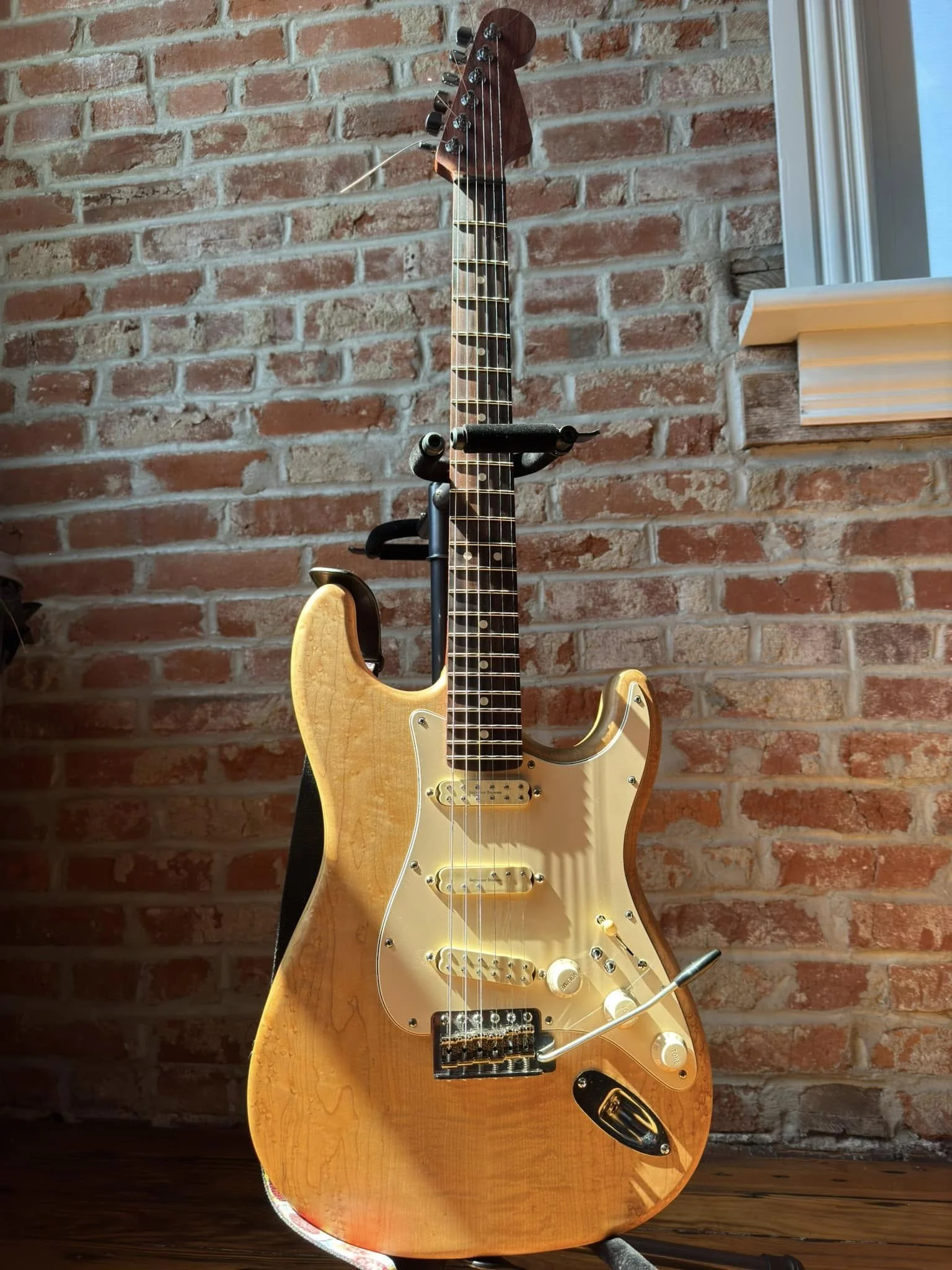
An electric guitar with a natural wood finish, white pickguard, and multiple control knobs, standing against a brick wall.

Here is an example the customized guitar program. This lesson plan is designed to guide students through a structured yet non-linear progression of fundamental guitar skills, musicality, and repertoire. Each session focuses on a balance of technique (posture, hand position, picking/strumming mechanics), foundational theory (chords, scales, rhythm, notation/tabs), and practical application (songs, exercises, and improvisation). Lessons are adaptable to the student’s age, experience level, and musical goals, ensuring steady skill development while keeping lessons engaging and musically relevant.

The plan emphasizes measurable weekly objectives and periodic milestones so both instructor and student can track progress. Typical lesson components include warm-ups, targeted technical work, theory integration, repertoire practice, and a brief review/assignment at the end. By following this sequence, students build reliable practice habits, improve sight-reading and ear skills, and gain confidence performing solo and in ensemble settings.

A colorful chart displaying a music learning curriculum, organized into categories such as Songs, Reading, Theory, Improvisation, Ear Training, Technique, Intervals, Arpeggios, Scales, and Chords, with different colored columns indicating different learning stages or levels.

CONTACT US

Interested in working together? Fill out some info and we will be in touch shortly.

We can’t wait to hear from you!